

For a UK business making its first offshore hire, the hardest part is often deciding exactly how the new person will work with the existing team. A list of tasks is useful, but the employee also needs working hours, access, examples, decision limits and someone who can answer questions.
Those details become more important when the team spans the UK and the Philippines. Your morning may fall late in the employee’s day, UK clock changes can move the overlap, and access to customer information needs to be considered before live work begins.
This guide sets out a practical first-month approach for a UK business hiring a dedicated team member through a Philippine staffing provider. The month begins when the employee starts work. It is an onboarding example, not a recruitment-time promise.
Choose one role with a clear purpose
Start with the function your business needs to support and the level of expertise it requires. A skilled employee in the Philippines can work alongside your internal team or take ownership of a role that can be performed remotely. You may be expanding a department, filling an open position or moving an existing role offshore. Group responsibilities that require a compatible level of skill and judgment.
Then describe the result the employee should produce. “Help with administration” leaves scope open to interpretation. “Keep customer records current, prepare the daily order-exception list and chase missing documents using approved messages” gives a candidate and manager something more concrete to discuss.
Avoid building the role around every task that colleagues would like to stop doing. A person hired for routine administration should not quietly become responsible for technical accounting, complex design and sales strategy as well. If the workload spans distinct professions, prioritise the first need or plan separate roles.
KamelBPO lets clients start with a job description or with the responsibilities they want to hand over. Recruitment and pre-screening follow the brief, while the client meets candidates and chooses the hire. The UK staffing guide explains the process and the available cost comparisons.
Assess communication using a realistic piece of work
For a customer-facing role, assess the English fluency and professional judgment the work needs. British spelling, your preferred tone, postcode checks and company terminology belong in your instructions. A candidate’s previous UK experience can help, but it does not replace learning your business.
A short exercise makes that distinction clear. For an employee whose responsibilities include invoice follow-ups, give the candidate fictional invoice INV-1042 for £950, due on 14 September 2026. State that it remains unpaid on 21 September, provide the customer’s name and ask for a polite first reminder. Explain that the employee may request a payment update but may not offer discounts or change the terms.
A suitable draft could read:
“Hi Alex, I’m following up on invoice INV-1042 for £950, which was due on 14 September. Could you let me know when we can expect payment? If you need another copy of the invoice or have a query, please let me know. Thank you.”
Assess the accuracy, clarity and tone against the instructions. This is a fictional sample used when selecting someone for a dedicated role. It shows how the candidate applies your process; it does not require them to guess your policies or complete unpaid customer work.
Agree the UK working window before the start date
Decide whether the role needs to follow your full UK day, overlap for a few hours or complete work before your UK team starts. Each can be workable, but each needs a different handover.
The Philippines currently uses UTC+8 without seasonal clock changes. The UK uses GMT in winter and BST in summer. A 9 a.m.–5 p.m. UK window therefore maps to the following Philippine times:
| UK clock period | Equivalent Philippine working window |
|---|---|
| GMT | 5 p.m.–1 a.m. the next day |
| BST | 4 p.m.–midnight at the end of the day |
In 2026, the UK changes its clocks on 29 March and 25 October. These are time conversions, not prescribed shifts; agree the employee’s hours and breaks with the provider. UK clock-change dates · Manila time-zone reference
If the requirement is “follow our UK hours”, confirm that the Philippine schedule will adjust when the UK clocks change. If the Philippine schedule stays fixed, your overlap changes instead. Put that choice in the working arrangement so the first affected Monday is routine.
Use calendar invitations set to the relevant locations, and state the calendar date where a shift crosses midnight. For asynchronous work, establish a deadline for the UK team to submit instructions and a time when someone will review the output.
Prepare the work before granting live access
Choose a small set of representative examples. Include one straightforward task, one incomplete request and one exception requiring a manager’s decision. Explain what a correct result looks like and why an exception must be referred.
For a customer-administration role, that could mean an approved response to an order-status question, an example record with missing information and a complaint that requires escalation. The employee should know which system contains the authoritative information and which actions they may take independently.
Set up individual accounts and access appropriate to the job. Test them before the first working session. Where possible, begin training with dummy or appropriately anonymised records so the employee can learn the workflow without unnecessary exposure to live customer information.
For personal data, check the arrangement rather than assuming UK hosting settles the question. The ICO explains that making personal information accessible to a separate organisation outside the UK can fall within the international-transfer rules, including through remote access. Assess whether the rules apply and put the appropriate arrangements in place before access begins. ICO’s brief guide to international transfers
A staffing provider’s involvement does not by itself establish that every proposed data flow is compliant. Identify who owns that assessment in your business and resolve the requirements before introducing live work.
Use the first month to build reliable ownership
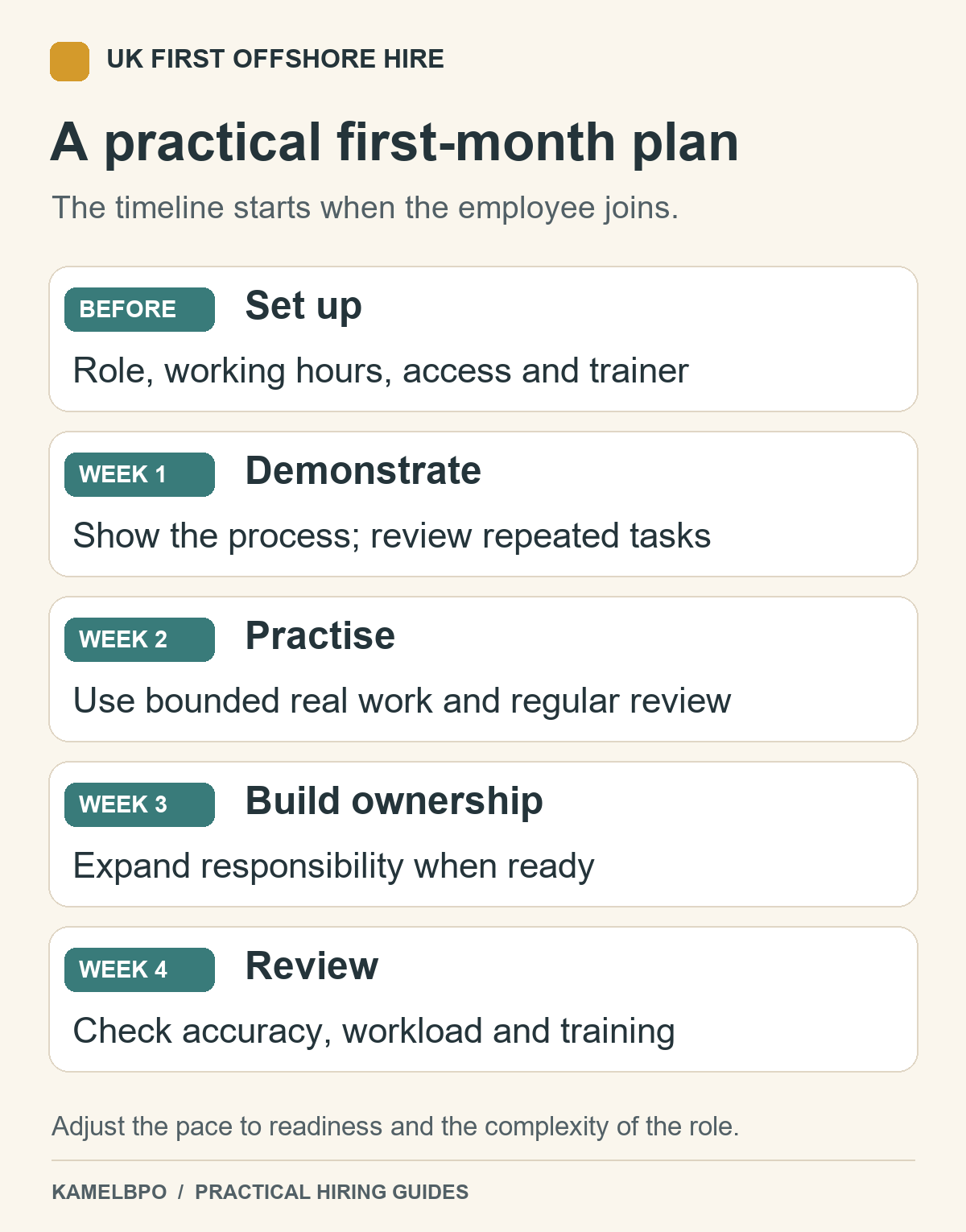
The following is an illustrative onboarding sequence. More complex roles may need longer, and the employee’s demonstrated readiness should determine how quickly responsibilities expand.
| Stage | Work to complete | Evidence that the next step makes sense |
|---|---|---|
| Before day one | Confirm responsibilities, hours, access, examples and the person providing training. | The employee can access the required tools and the manager has prepared a usable brief. |
| Week one | Demonstrate the core workflow; let the employee repeat it with close review. | They can explain the steps and recognise the exceptions that need help. |
| Week two | Assign a bounded set of real tasks and review the results regularly. | Work meets the agreed checks and questions reach the right person. |
| Week three | Increase ownership where the evidence supports it. | The employee can complete routine work and maintain a useful handover. |
| Week four | Review accuracy, delays, workload and remaining training needs. | The next month’s priorities and decision limits are clear to both sides. |
Do not use the first month solely to measure speed. An employee who processes more items but repeatedly creates rework has not necessarily improved capacity. Look at completeness, accuracy, appropriate escalation and how much work is waiting for a decision.
Give feedback against an example whenever possible. “Be more proactive” is difficult to act on. “When the delivery date is missing, request it from the supplier and record the follow-up date before returning the file” explains the behaviour you want.
Show how the arrangement works on an ordinary day
Consider a hypothetical UK online retailer hiring an offshore customer-administration employee. The person prepares the daily order-exception list, requests missing delivery information and drafts responses using approved guidance. Refund exceptions remain with the UK operations manager.
The business chooses a UK-aligned shift so the manager can answer questions during the same working day. At 9 a.m. UK time, the employee reviews the queue and identifies issues requiring a decision. A short discussion settles priorities; the rest of the work happens in the shared system.
At the end of the shift, the handover records each unresolved item, the latest action, the next action and its owner. If a supplier has not answered, the record shows when to follow up. If a customer needs an exception, it names the UK manager responsible for deciding.
The handover should also preserve the details a UK customer expects to see correctly: pound amounts, the relevant order reference, an unambiguous date and the company’s approved terminology. Use written dates where a numeric format could be misread. These requirements belong in the brief, rather than being left for the new employee to infer.
This is an example of a workable routine, not a claim about a particular KamelBPO client or guaranteed output.
Agree holiday coverage around your UK business
KamelBPO arranges staffing around the client’s agreed working calendar. A UK bank holiday does not automatically mean a day off for the Philippine employee. You can arrange continued coverage while your UK office is closed, or agree time off that follows your business’s closure dates. The UK itself has different bank-holiday calendars for England and Wales, Scotland and Northern Ireland, so specify the dates relevant to your operation. UK bank-holiday calendars
Your customers may expect responses even when your own office is closed. Conversely, an employee may be scheduled to work when the UK colleague who approves exceptions is unavailable. Discuss these situations in advance and identify the backup decision-maker or the response that should be used until someone returns.
KamelBPO handles Philippine holiday entitlements and applicable holiday premium pay through its employment and payroll administration. Your account manager can coordinate the agreed schedule, planned leave and coverage requirements with you. Keep the customer-service calendar and the employee’s individual working arrangements clear so support continues as agreed throughout the year.
Keep management responsibilities clear
With KamelBPO’s dedicated staffing model, your business sets priorities, supplies its workflows and job-specific training, and reviews the employee’s work. KamelBPO handles employment, HR, payroll and included workplace support, with an account manager supporting the relationship.
That division gives the employee a place in your operating process while the provider supports the employment arrangement. It also tells you what to prepare: hiring offshore does not remove the need for a UK colleague who understands the work and can make decisions.
Budget for that person’s involvement, particularly during onboarding. When using a GBP estimate, also read the currency and billing explanation. KamelBPO’s calculator offers local-currency comparisons while billing is primarily based in USD; the final quote should confirm the applicable terms.
Estimate your offshore staffing costs in GBP
Choose a role and experience level to compare a Philippine staffing estimate with the UK salary reference.
Choose a role to see your estimate.
Planning estimates only. The local salary reference is not a full employer-cost calculation. We primarily bill in USD; confirm inclusions, working hours and the final price in your quote.
Finish the month with a better brief
By the end of the first month, you should have a clearer view of the work than you had when recruiting. Record which responsibilities the employee now owns, which decisions still need review and which instructions need improvement.
If work repeatedly stalls, identify the cause before adding more duties. The issue may be missing access, ambiguous instructions, insufficient training or an approval process that does not fit the schedule. Expanding the role before resolving those issues can increase the backlog instead of reducing it.
For a first conversation about staffing, bring the responsibilities, UK working window, tools and level of experience you need. KamelBPO’s UK offshore staffing page gives you a place to explore roles and discuss a dedicated hire around those requirements.