

An American business can work with a dedicated employee in the Philippines during US business hours. The arrangement needs to be built around a specific schedule, though. A customer support team in New York, a design firm in Denver and an operations team in Los Angeles do not have the same working day.
Before you recruit, decide when the person needs to be available, which decisions require a US colleague and what should happen when that colleague is offline. Those details determine whether offshore staffing gives you useful capacity or leaves work waiting for someone to answer a question.
This guide explains how to plan the working hours, handovers and responsibilities for a Philippine team supporting a US business.
That support can sit across your business. A skilled employee in the Philippines can work alongside your internal staff or take ownership of a defined role that can be performed remotely. You might be expanding a department, filling an open position or moving an existing role offshore. Start with the function and level of expertise you need, then recruit someone with the corresponding skills.
Start with the hours your work needs
“Work our hours” is a reasonable starting point, but it is not a complete staffing brief. Specify the US city or time zone, working days, required coverage window and whether the schedule follows local daylight saving changes.
Then separate tasks that need an immediate response from tasks that can wait for a review.
An employee answering customer calls needs to be available during the advertised service window. A person cleaning CRM records may only need a scheduled check-in and a clear way to flag exceptions. A developer can complete some work independently, but may still need access to someone who can resolve a requirement or review a change.
The task list should drive the schedule. Requiring every role to follow the same shift can create unnecessary overnight work without improving the result.
What a US working day looks like in the Philippines
The Philippines uses UTC+8 and currently does not change its clocks for daylight saving time. Most US locations do, so the difference changes during the year. Manila time-zone reference · US daylight saving rules
The table translates a 9 a.m.–5 p.m. local working window on two example dates. It shows clock times, not a promise of uninterrupted coverage or a particular employment schedule.
| US location | Philippine time on January 15, 2026 | Philippine time on July 15, 2026 |
|---|---|---|
| New York | 10 p.m.–6 a.m. next day | 9 p.m.–5 a.m. next day |
| Chicago | 11 p.m.–7 a.m. next day | 10 p.m.–6 a.m. next day |
| Denver | Midnight–8 a.m., both on the next day | 11 p.m.–7 a.m. next day |
| Los Angeles | 1 a.m.–9 a.m., both on the next day | Midnight–8 a.m., both on the next day |
These examples use the named cities. Do not apply Denver’s seasonal schedule automatically to Phoenix, or assume every US location changes its clocks. NIST identifies the principal exceptions, including Hawaii and most of Arizona, in its daylight saving guidance linked above.
Write recurring meetings using named time zones in your calendar. “Monday at 9 a.m. New York time” is clearer than “Monday morning,” especially when the Philippine shift crosses midnight.
Choose the coverage arrangement deliberately
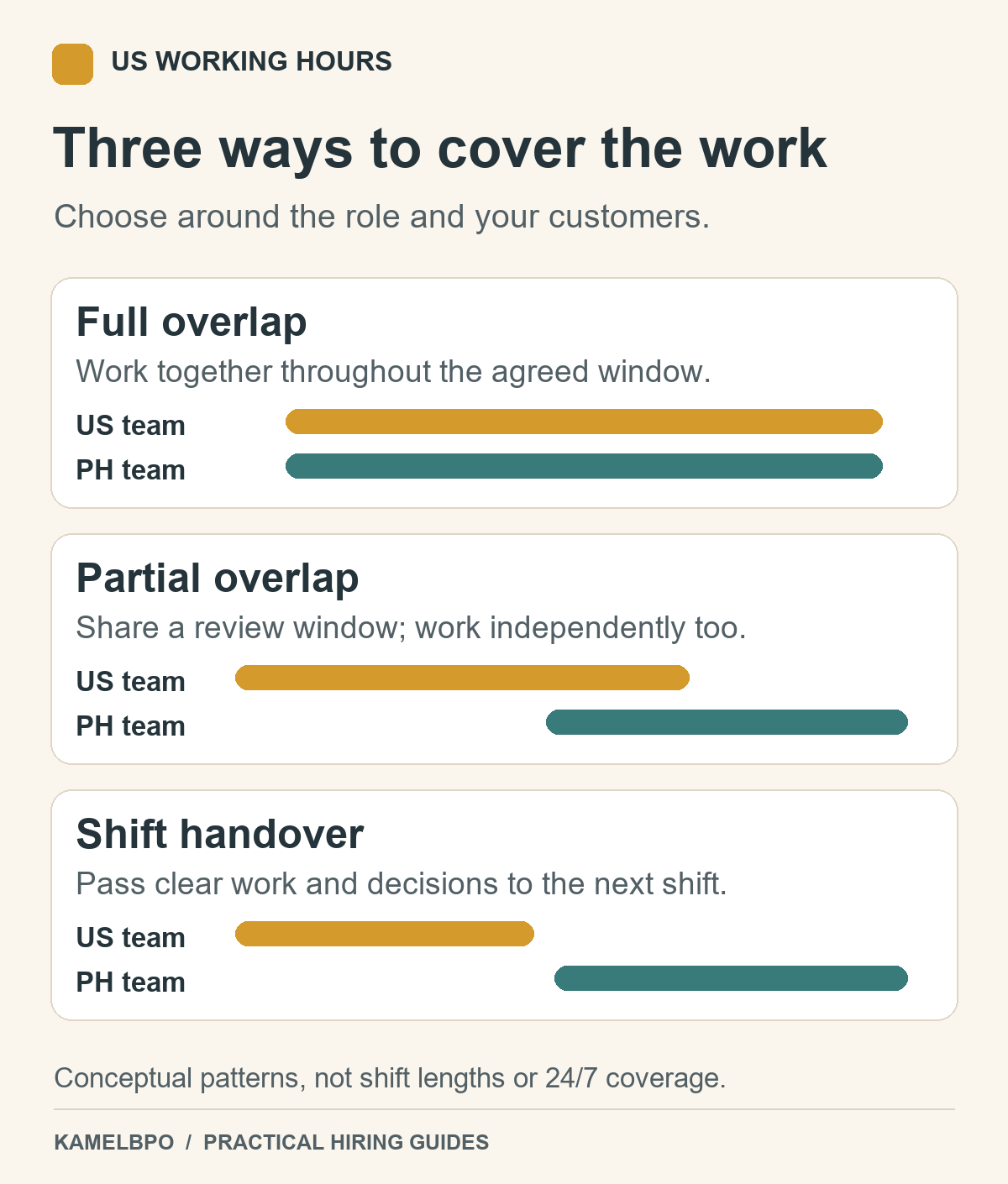
There are three useful ways to organize the work. The right choice depends on response expectations and how much support the new employee needs.
Full overlap means the offshore working window closely follows the US team’s day. It can suit live customer support, appointment coordination or work requiring frequent discussion. The US manager must actually be available during that window; simultaneous working hours do not help if approvals still take a day.
Partial overlap reserves a shared period for instructions, reviews and decisions, with independent work outside it. This can suit reporting, design production, administration or development when tasks are sufficiently defined. Agree when questions will be answered and what the person should work on while waiting.
A handover between shifts lets one team pass defined work to the other. A US team might prepare requests before finishing, with the Philippine team processing them before the next US morning. This works best when inputs are complete and exceptions have a clear route. A vague instruction sent at the end of the day can leave the next shift blocked for hours.
These are scheduling options to discuss with a provider. They are not interchangeable packages, and a dedicated employee should not be assumed to cover all three.
A practical example for a New York business
Consider an illustrative New York business that needs help with order enquiries and routine customer follow-ups from 9 a.m. to 5 p.m. Its US operations manager retains responsibility for exceptions such as unusual refunds and delivery promises.
The brief should describe the work and the limits together:
| Part of the arrangement | Example instruction |
|---|---|
| Main duties | Answer order-status enquiries, update the customer record and follow up on missing information. |
| Coverage requirement | Weekday service during New York business hours, with breaks and backup arrangements agreed separately. |
| Decision authority | Follow approved policies; refer exceptions to the operations manager before making a commitment. |
| Review | Review a sample of responses and unresolved cases with the manager each day during onboarding. |
| End-of-shift handover | List open cases, the action already taken, the next action, its owner and the promised response time. |
During New York’s daylight saving period, the illustrated 9 a.m.–5 p.m. window corresponds to 9 p.m.–5 a.m. in the Philippines. The provider and employee need to agree how the schedule changes when New York returns to standard time.
The important operational detail is the exception owner. If a customer needs an answer that the offshore employee cannot authorize, somebody in the US needs to be reachable. Giving the employee a clear escalation route protects the customer experience and avoids encouraging guesses.
Plan for breaks and absences before promising coverage
A staffing schedule and a customer-service promise are different things. One employee may have an agreed eight-hour working window, but that does not establish eight hours of uninterrupted phone availability. Breaks, meetings, training and absence all affect coverage.
If the business promises continuous service, identify who takes over when the employee is unavailable. That could be a US colleague, another team member or a separately agreed coverage arrangement. The quote should make that arrangement clear.
Set the holiday schedule around your US operation
KamelBPO arranges staffing around the client’s agreed schedule, including coverage across the year. A US public holiday does not automatically mean the Philippine employee takes that day off. If your business needs support over Thanksgiving, for example, you can discuss continued coverage; if you close and want the employee to take time off, that can be arranged too.
KamelBPO handles Philippine holiday entitlements and applicable holiday premium pay through its employment and payroll administration. Agree the working calendar, planned time off and coverage with your account manager. If US colleagues will be away while the offshore employee works, identify who can approve exceptions or what can proceed independently.
Prepare the employee to communicate with your US customers
Hire for the English fluency, professional skills and judgment the role requires. Then provide the knowledge specific to your business: its terminology, service areas, customer policies and preferred writing style. Prior experience serving US customers can help, but it should be assessed rather than assumed.
An employee does not need to memorize every US ZIP code or state abbreviation. They need to know where to verify an address, which locations your business serves and when to ask for clarification. Appointment confirmations should state the date and the customer’s time zone explicitly. Give the employee reliable reference material and examples of good customer communication.
Where your customers need Spanish-language support, include Spanish alongside English in the recruitment brief and assess the required spoken and written fluency. KamelBPO can recruit for that requirement; candidate availability and the role’s other skills still need to be matched to the brief.
Give the employee a way to finish the work
A useful handover contains enough information to act without another meeting. For each open item, record the relevant customer or project reference, what has already happened, the required next step, the deadline and the person who can make a decision.
For example, “Please follow up on the shipment” leaves too much unanswered. A better instruction is: “The carrier has not confirmed the revised delivery date. Check the tracking record at the start of the shift, request an update if it is unchanged and send the customer the approved holding response. Escalate to the operations manager before promising a new date.”
That is an illustrative workflow, not a customer case. Its value is the decision boundary: the employee can make progress while knowing when to stop and ask.
Provide access to the systems needed for those actions before the first live shift. Test the accounts and permissions, establish an agreed place for work updates and identify who can resolve access problems during the Philippine employee’s actual working hours.
For customer information, agree individual access permissions, handling instructions and a clear incident-reporting contact before the employee starts. The FTC recommends checking service providers’ security practices and documenting relevant requirements in contracts. Your business should also identify any state or industry requirements that apply to its particular information and work. FTC guidance on service-provider security
Compare the staffing offer against the schedule
When requesting a quote, specify the role, experience, tasks, required hours and the tools the employee will use. Ask which workplace and employment costs are included, what your company must provide and how changes to the agreed schedule are handled.
At KamelBPO, clients set the day-to-day priorities, provide their workflows and job-specific training, and review the work. KamelBPO recruits and pre-screens candidates and handles employment, HR, payroll and included workplace support. Staffing is arranged around the agreed shift and coverage requirements. The US offshore staffing guide explains the arrangement and provides role-based cost comparisons.
A cost estimate helps with planning. The quote should confirm the actual requirements, particularly where a role needs specific software, specialist experience or a coverage arrangement beyond one person’s normal schedule.
Estimate your offshore staffing costs in USD
Choose a role and experience level to compare a Philippine staffing estimate with the US salary reference.
Choose a role to see your estimate.
Planning estimates only. The local salary reference is not a full employer-cost calculation. We primarily bill in USD; confirm inclusions, working hours and the final price in your quote.
Make the first hire easier to manage
Start with a defined set of recurring responsibilities and one person on the US side who owns training and feedback. During onboarding, review accuracy, outstanding questions and the time work spends waiting for a decision. Those observations will tell you whether to improve the instructions, change the overlap window or adjust the scope.
The most useful first discussion with a staffing provider is specific: “We need help with these responsibilities, during these hours, using these systems.” It gives recruitment a clear target and makes the eventual working relationship easier to assess.
To explore that arrangement, visit KamelBPO’s US staffing page and share the work, experience and coverage your business needs. You can start with the responsibilities even if you have not settled on a job title.