

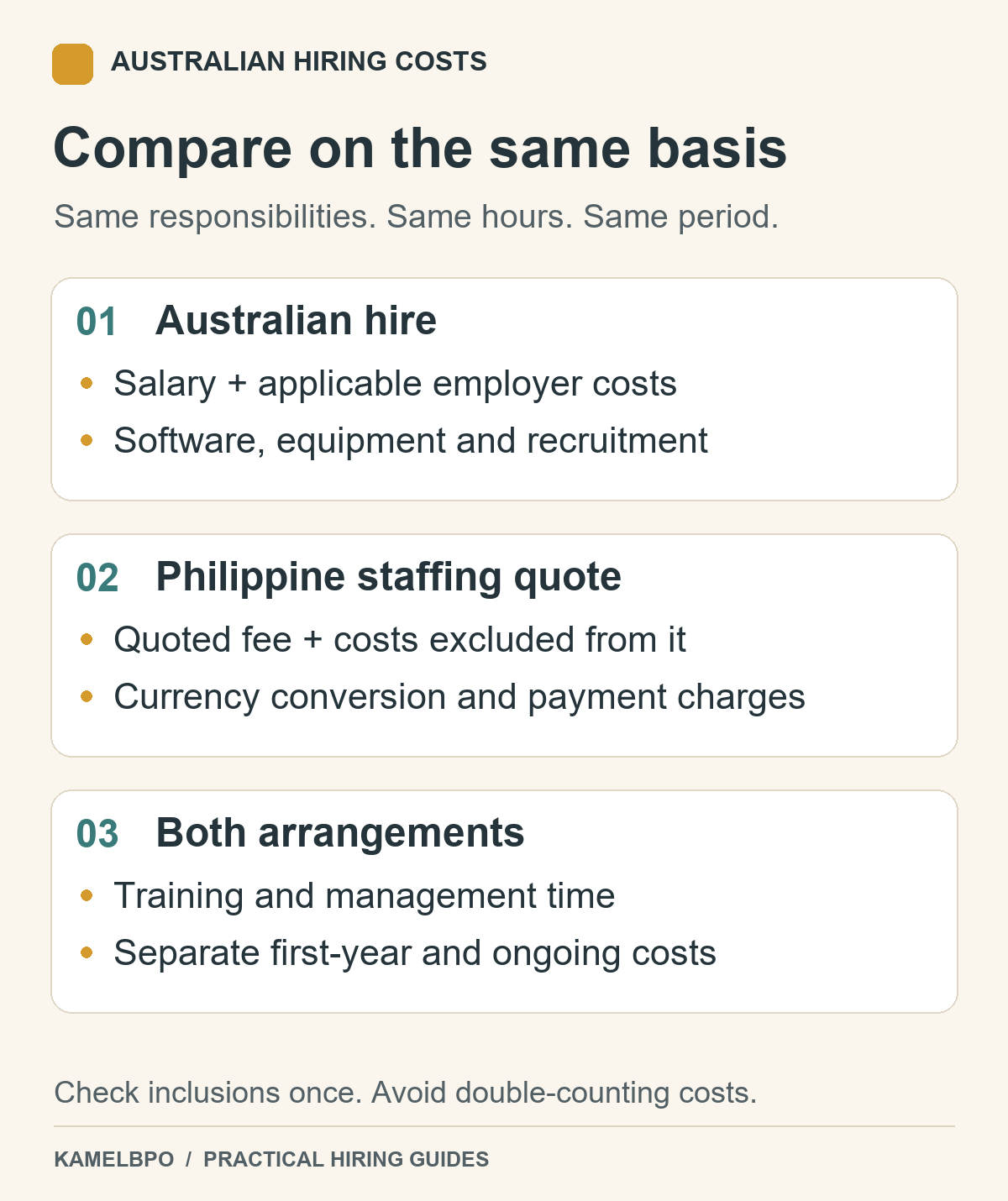
An Australian business comparing a local employee with offshore staff needs more than two monthly figures. The useful comparison is what each arrangement costs to deliver the same work, at the required standard, during the hours the business needs.
A local salary may exclude superannuation. An offshore quotation may include employment administration and equipment but leave job-specific software with the client. One role may require frequent supervision; another may need an experienced person who can work independently. These differences matter before any savings percentage does.
If you are considering outsourcing to the Philippines from Australia, start by defining the role, then build a consistent cost comparison around it.
The role can support an existing Australian team or carry its own responsibilities within a business function. Skilled Philippine staff can help you expand a department, fill a vacancy or move a role offshore where the work can be performed remotely. Match the person’s expertise to the function you need; offshore staffing is not limited to basic administrative assistance.
Compare the same job on both sides
Write down the recurring responsibilities, expected experience, systems and working hours. Use that brief for the local role and the offshore quote.
For example, an accounts administrator who prepares invoices, follows up missing documents and maintains records is a different hire from an accountant responsible for complex reporting. Comparing the first person’s offshore cost with the second person’s Australian salary would overstate what the arrangement delivers.
The same problem occurs when a part-time contractor’s rate is compared with a dedicated full-time employee, or when a junior person is compared with an experienced specialist. The figures can both be accurate while the comparison remains misleading.
Describe what the person should own, which decisions remain with your Australian team and how much independent judgment the role requires. That gives both recruitment and budgeting a useful foundation.
Check whether the Australian salary includes super
Clarify whether a proposed local salary is a base salary plus superannuation or a total package that already includes it. Adding super to an inclusive package would count it twice; leaving it out of an exclusive salary would understate the comparison.
As at September 2026, the Fair Work Ombudsman’s guidance states that the superannuation guarantee is 12% of qualifying earnings for eligible employees. Use the applicable earnings basis and check any additional award or agreement requirements for the actual role. Fair Work guidance on tax and superannuation
Here is an illustrative first-year calculation. The salary and other expense amounts are chosen to demonstrate the method. They are not a market salary benchmark or a KamelBPO quote.
| Selected local hiring expense | Illustrative amount in AUD |
|---|---|
| Base salary, excluding super | $80,000 |
| Super at 12%, assuming the full salary is qualifying earnings | $9,600 |
| Software licences | $1,800 |
| Equipment purchased in the first year | $1,200 |
| Recruitment expenditure | $2,400 |
| Selected first-year expenses | $95,000 |
That subtotal is not the complete cost for every employer. Add other expenses that apply to your business, such as workers compensation insurance, payroll tax where applicable, workplace costs and any additional benefits or allowances. Record which figures are actual incremental expenses and which are allocations of overhead you will continue paying anyway.
Be consistent about paid leave. If an annual salary continues during leave, that salary cost is already in the annual figure. Additional cover may create an extra cost; the same salary should not simply be added again as a separate leave expense.
Separate the first year from the ongoing run rate
Recruitment and initial equipment purchases do not necessarily recur every year at the same amount. A first-year comparison should show those costs, while an ongoing comparison should use a sensible replacement or renewal basis.
Likewise, avoid assuming every local overhead disappears when work moves offshore. If your office lease stays the same, allocating part of that lease to one employee does not make the allocated amount a cash saving. Identify the expenditure that changes and the capacity you gain.
This distinction is useful when presenting the proposal internally. “Our modeled cost per position falls” and “we will spend this much less next year” are different claims. Both can be worth evaluating, but they need their own calculation.
Find out what the offshore quote covers
Ask for a written description of the staffing arrangement before comparing its headline price with the local cost.
| Question to settle | Why it affects the comparison |
|---|---|
| Is the employee dedicated to our business? | Shared coverage and a dedicated role provide different capacity. |
| What working days and hours are included? | The same monthly price may represent a different service window. |
| Which employment and workplace costs are included? | HR, payroll, office equipment and support should be counted once. |
| Which software and access costs remain ours? | Specialist licences and client systems can change the budget. |
| Who provides task-specific training and supervision? | Your team still needs time to establish and manage the work. |
| What happens when we change the scope or hours? | A revised role may need a revised quote or a different candidate. |
KamelBPO’s staffing model includes employment and workplace support, with clients directing the employee’s daily work. Its Australian offshore staffing page explains the inclusions and lets you compare roles and experience levels. Confirm any role-specific requirements in the quote.
Estimate your offshore staffing costs in AUD
Choose a role and experience level to compare a Philippine staffing estimate with the Australian salary reference.
Choose a role to see your estimate.
Planning estimates only. The local salary reference is not a full employer-cost calculation. We primarily bill in USD; confirm inclusions, working hours and the final price in your quote.
Keep AUD budgeting separate from invoice currency
An estimate displayed in Australian dollars is useful for comparison. It does not necessarily mean the provider invoices in AUD or guarantees that converted amount for the life of the arrangement.
KamelBPO’s calculator presents local-currency comparisons while its billing basis is primarily USD. Read the current currency explanation and confirm the invoice currency in your quote. Your payment provider’s conversion rate and charges can affect the amount that leaves your Australian bank account.
For budgeting, record the original quoted currency, the conversion rate used, the date of that rate and any payment charges. Compare both options over the same period. If the offshore fee is monthly, use the actual agreed billing basis to create an annual view rather than mixing it with an unrelated hourly estimate.
The calculator’s Australian salary comparison is an indicative reference. It is not a complete calculation of every Australian employer cost in your business. Add your own verified inputs when preparing the full hiring comparison.
Include your Australian manager’s time
An offshore employee needs context, priorities and feedback. A local employee does too. Compare the management effort realistically for each arrangement rather than assigning it to only one side.
During onboarding, someone must explain the systems, review early work and resolve exceptions. After the role settles, the requirement may change. Keep initial training effort separate from the expected ongoing management time.
Consider an Australian business handing over invoice preparation. It can reduce avoidable back-and-forth by providing approved invoice examples, a checklist for required supporting documents and a clear rule for escalating discrepancies. A lower staffing fee will be less useful if the Australian manager spends each afternoon reconstructing incomplete instructions.
The answer is to improve the handover and hire for the appropriate level of judgment. It is not to assume that management disappears from the cost model.
Build Australian customer knowledge into onboarding
For a customer-facing role, assess English fluency and the ability to communicate clearly through the channels your business uses. Then teach the employee your Australian terminology, preferred spelling, customer policies and service areas. Experience with Australian clients is useful when relevant, but familiarity with every suburb or postcode should never be assumed.
Provide a reliable address lookup or service-area reference and explain how to use it. The practical skill is checking the customer’s location correctly, asking for missing details and giving an accurate response. A suburb name on its own may not provide all the information your team needs.
For appointment coordination, specify the local date, time and location in the confirmation. These are everyday responsibilities of an employee working in your business, with your systems and instructions. They belong in the onboarding plan and should be assessed against the actual job.
Arrange access to Australian customer information
If the employee needs customer records, decide which information the role requires and how access will be controlled. Give the person an individual account with appropriate permissions and explain how to report an error or security concern.
For businesses subject to the Australian Privacy Principles, overseas disclosure can bring obligations under APP 8. The OAIC explains that reasonable steps may be needed to protect the information and that the nature of the arrangement matters. Resolve the relevant requirements before granting access. OAIC guidance on sending personal information overseas
Match the schedule to your Australian location
The time difference is manageable only when the actual working window suits the role. Perth, Brisbane and Sydney should not be treated as one schedule. Australia has several time zones, and daylight saving arrangements differ between states and territories. Tourism Australia’s time-zone guide
These calculated examples translate a local 9 a.m.–5 p.m. window into Philippine time:
| Australian location | January 15, 2026 | July 15, 2026 |
|---|---|---|
| Perth | 9 a.m.–5 p.m. | 9 a.m.–5 p.m. |
| Brisbane | 7 a.m.–3 p.m. | 7 a.m.–3 p.m. |
| Sydney | 6 a.m.–2 p.m. | 7 a.m.–3 p.m. |
All times in the last two columns are on the same calendar day. The Philippines currently stays on UTC+8 throughout the year. These are clock conversions; working hours, breaks and coverage still need agreement. Manila time-zone reference
If most work can be completed independently, you may prefer a narrower shared window for reviews. If the person needs to answer customers throughout your local day, make that requirement explicit before recruiting.
Australian public holidays and your own business closures also belong in the schedule. An Australian holiday does not automatically make it a day off for the Philippine employee. With KamelBPO, you can arrange continued support or time off around your business calendar. KamelBPO administers Philippine holiday entitlements and applicable premium pay. Confirm the agreed shifts, planned leave and any coverage changes with your account manager so the working arrangement matches your Australian operation.
Use the comparison to make a hiring decision
Once the costs are on a consistent basis, consider whether the work is suitable for an offshore employee. Recurring work in shared systems can be a useful starting point when your team can define, train and review it. Work that requires a physical presence at an Australian premises needs a different arrangement, even if some supporting administration can be handled remotely.
Ask what the hire will make possible: clearing a recurring backlog, keeping records current, increasing customer-response capacity or freeing an existing specialist from routine preparation. Define how you will recognise a good result and include the people needed to support it.
To build a comparison around your actual work, use KamelBPO’s Australian staffing guide and calculator. Share the responsibilities, tools, experience and Australian working hours you need so the quote can reflect the role you are genuinely trying to fill.
Discuss your Australian staffing requirements with KamelBPO.