
When outsourcing was just about cost savings
In the earlier outsourcing model, most companies sent work offshore for one main reason: lower operating costs. The tasks were usually repetitive, rules-based, and easy to separate from the rest of the business. Common examples included data entry, basic customer support, and routine administrative work such as inbox management, scheduling, and document processing. Deloitte’s Global Outsourcing Survey notes that cost reduction remained a central outsourcing driver for many organizations, especially in more traditional models. OECD research also shows that earlier waves of service offshoring often focused on routine activities that firms viewed as outside their core business functions.
Because of that setup, companies often managed offshore teams as task handlers rather than decision makers. Work was assigned in small pieces, instructions were tightly controlled, and ownership stayed with onshore managers. In practice, this meant offshore staff completed requests but rarely shaped workflows, improved systems, or influenced outcomes. Research on service offshoring describes this model as highly segmented, with work carved into standardized units that could be moved and monitored from a distance. As a result, offshore teams had minimal integration with core departments and limited visibility into broader business goals.
However, that old model came with clear limits. When work moved through too many handoffs, processes slowed down. When communication depended on rigid instructions alone, misunderstandings became more likely. Studies on offshoring have identified these hidden coordination costs, including communication friction, distance-related challenges, and operating issues that reduce the value of low-cost labor if the work requires frequent interaction. In many cases, offshore support helped complete tasks, but it did not create much strategic impact because the team had little authority, little context, and little connection to the company’s main operating priorities.
Why have businesses started relying on offshore teams for critical work
Several forces changed how companies view offshore work. First, businesses gained better access to global talent through remote collaboration and digital delivery tools. Research on global virtual work shows that communication platforms, cloud systems, and shared project tools now make it easier for teams in different countries to work together on complex tasks, not just simple assignments. At the same time, Deloitte reports that global business services organizations are expanding their functional scope and investing more in digital, analytics, and customer-facing capabilities. This shows that offshore models are no longer limited to low-value support work.
Second, the business environment itself became harder to manage through local hiring alone. Companies face tighter labor markets, higher wage pressure, and growing demand for specialized skills. The World Economic Forum has repeatedly highlighted global skills shortages and the need for skills-first hiring because many employers struggle to fill critical roles fast enough. Deloitte’s 2024 outsourcing survey also notes that organizations now use a wider mix of sourcing models to access talent, skills, and capabilities that may be difficult or expensive to secure in one local market. In practical terms, hiring nearby is often slower, more expensive, and less flexible than leaders need.
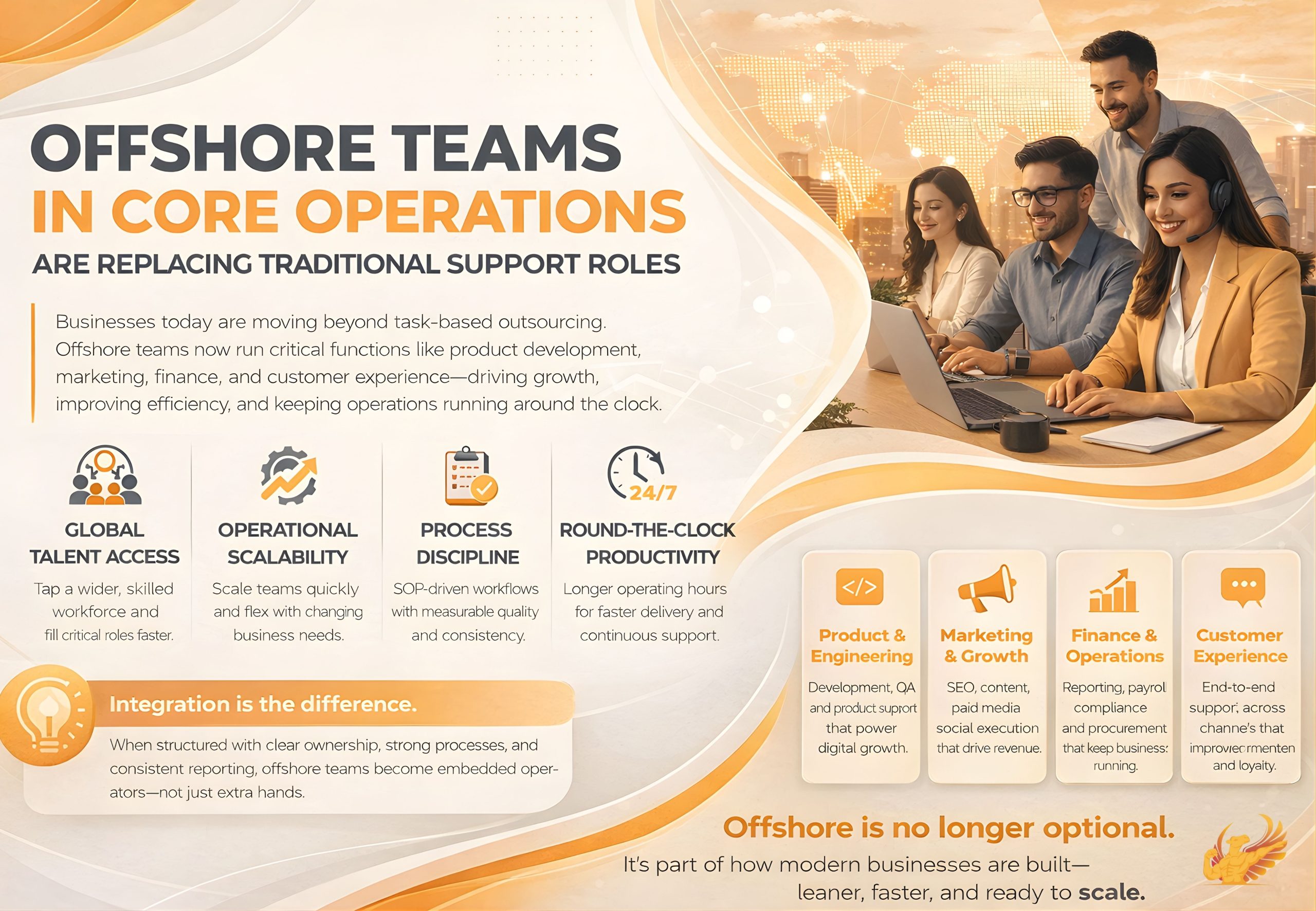
As a result, offshore work evolved from task execution to function ownership. OECD analysis shows that offshoring moved beyond routine services into knowledge-intensive business functions such as product design, engineering, and research. Earlier work was often separated from the core business, but later waves of offshoring included higher-value activities that required more expertise and stronger integration with the main organization. This shift matters because it changed what companies expected from offshore teams. Instead of simply finishing assigned tasks, they began managing workflows, timelines, and outputs tied to business performance.
From support roles to revenue and operations drivers
The scope of offshore work has expanded because businesses now need capacity in functions that directly affect output, growth, and customer outcomes. Deloitte’s 2025 Global Business Services Survey says leading organizations are using global and multifunctional delivery models, expanding beyond traditional functional scopes, and accelerating digital capabilities. In the same report, Deloitte notes that companies are increasing their footprint because of new functions and market needs, which shows that offshore delivery now supports much more than routine back office activity.
In product and engineering, offshore teams often support work that sits close to the business itself. This includes full-stack development, quality assurance, testing, and product support. These responsibilities matter because they shape release speed, product stability, and user experience. OECD analysis explains that offshoring now includes services and higher-value business activities, not only basic support work relocated abroad. In practice, that shift allows companies to place technical execution within globally distributed teams that help build, maintain, and improve products on an ongoing basis.
Marketing has also moved far beyond auxiliary support. Offshore teams now handle SEO, content production, paid ads management, and social media execution across multiple channels. These functions influence visibility, lead flow, conversion, and brand consistency, which makes them commercially important rather than peripheral. Deloitte’s 2024 outsourcing survey says organizations are using broader sourcing models to access talent, skills, and capabilities, while its 2025 GBS survey highlights continued investment in digital initiatives and customer experience. Together, those findings support the broader shift toward offshore marketing teams that help drive measurable business performance.
Finance and operations show the same pattern. Offshore teams now manage bookkeeping, reporting, payroll processes, compliance support, and procurement coordination. These functions are tied to business control, cash visibility, continuity, and decision making. Deloitte identifies finance as one of the top functions where digital and analytics use cases are being implemented inside global business services environments. That matters because reporting accuracy, payroll reliability, and procurement discipline are operational foundations, not side tasks.
Customer experience is another area where offshore delivery has become central. McKinsey reports that customer care leaders now balance customer experience with revenue goals, technology transformation, and stronger outsourcing relationships. It also notes that retention, upselling, and operational improvement are now core priorities in customer care. That means omnichannel support, lifecycle management, and proactive engagement contribute directly to loyalty and revenue. In other words, offshore teams in core operations are not simply answering tickets or clearing queues. They are helping companies protect delivery, improve performance, and support revenue across essential business functions.
The operational advantages that changed everything
Offshore teams became more central because they solve several business problems at once. Cost efficiency is still part of the picture, but the value now goes further than lower labor expense. Deloitte’s 2025 Global Business Services Survey says leading organizations are building more agile, digital, and cost-efficient delivery models, while McKinsey notes that global business services can streamline and standardize work across large organizations and give business units efficient access to global talent. In practice, that means companies can redirect savings into product development, customer experience, technology, and other growth priorities instead of treating offshore support as a narrow cost play.
Scalability also changed the equation. Many companies cannot wait through long hiring cycles in one local market, especially when demand changes quickly or specialized roles are hard to fill. The World Economic Forum has pointed to persistent labor and skills shortages, which push employers to widen the talent pool and adopt more flexible hiring models. That pressure makes offshore staffing more attractive because teams can expand faster and adjust capacity with less disruption. As a result, leaders can respond to growth, new projects, and operational spikes without overloading in-house teams or slowing down delivery.
At the same time, offshore teams work best when companies build them around process discipline. McKinsey highlights the value of standardized, fast, and consistent service at scale in global business services models. That matters because offshore delivery becomes stronger when teams follow clear workflows, documented procedures, and measurable outputs. Instead of depending on informal handoffs or one person’s memory, companies can run work through SOP-based systems with visible timelines, quality checks, and reporting. This is one reason offshore teams in core operations now handle work that directly affects performance. They are easier to integrate into repeatable, accountable operating models.
Time zone coverage adds another operational advantage. With teams working across regions, businesses can maintain continuity outside standard local office hours, support customers across markets, and keep projects moving through longer operating windows. Talent quality also matters here, especially in the Philippines. IBPAP states that its member companies provide full English language support, and the sector continues to grow in jobs and export revenue, which reflects deep experience serving global companies. Together, these factors explain why offshore works best as a structured system. It creates value when companies design it for continuity, accountability, and scale rather than treat it as a shortcut.
Turning offshore teams into embedded operators
Companies do not turn offshore teams into core operators by hiring quickly and hoping the setup works. They do it by building a clear operating model around the work itself. Research from McKinsey shows that strong global business services models improve performance when companies streamline and standardize processes across functions, while Deloitte’s 2025 Global Business Services Survey points to more agile, digital, and cost-efficient delivery models as a defining direction for leading organizations. In other words, integration starts with structure, not headcount.
Phase 1 is to identify core processes. Companies first map the workflows that repeat often, affect delivery, and depend on consistency. They then define who owns each workflow, where decisions sit, and what outcomes matter. McKinsey notes that operating models perform better when organizations redesign workflows and governance with clear accountability, because gaps between strategy and delivery often come from weak operating structures. This is why businesses should not offshore scattered tasks alone. They should identify complete processes that can be managed with clear ownership.
Phase 2 is to document and standardize. Once a process is selected, companies need SOPs, shared tools, clear system access, and measurable KPIs. Deloitte notes that global business services are well placed to improve standardization and automation, reduce cycle times, and increase productivity when they manage end-to-end processes with a centralized view. This matters because offshore delivery becomes more reliable when expectations are visible and measurable rather than informal or assumed.
Phase 3 is to assign ownership. At this point, offshore teams should manage full workflows, not just isolated requests. OECD analysis shows that offshoring has expanded from routine support into more knowledge-intensive and higher-value business functions. That shift supports a model where offshore teams do not simply wait for instructions. Instead, they handle execution across a defined process, monitor output, and keep work moving. That is the practical difference between extra capacity and offshore teams in core operations.
Phase 4 is to build a reporting rhythm. Weekly dashboards, service metrics, exception logs, and performance reviews help companies track quality, speed, and capacity. Phase 5 is to add oversight through QA systems, team leads, or function managers who review work, solve issues, and protect standards. McKinsey and Deloitte both emphasize governance, consistency, and measurable delivery as key parts of effective global service models. Integration is what turns offshore into core because it connects people, process, accountability, and performance in one system.
Why some offshore setups fail to scale
Some offshore setups stay stuck in support mode because the business never builds real ownership into the model. Work gets handed off task by task, but no one owns the full process, the output, or the final result. McKinsey’s work on operating models shows that performance gaps often come from unclear accountability and weak governance. Deloitte also points out that global business services create more value when organizations standardize processes and manage them with a centralized view rather than as disconnected activities. When ownership is unclear, offshore teams can stay busy without becoming truly accountable for outcomes.
Another common problem is the lack of structure. Companies delegate work without SOPs, system rules, quality checks, or a clear communication rhythm. Research on service offshoring has long noted that coordination costs rise when work depends on constant clarification, fragmented instructions, and distance-sensitive communication. In plain terms, people spend too much time chasing context instead of moving work forward. That slows workflows, increases rework, and makes offshore delivery look less capable than it really is.
The same issue appears when companies skip KPIs and reporting. If leaders do not track turnaround time, quality, output, and exceptions, they cannot manage performance in a serious way. Deloitte’s global business services research stresses the role of standardization, automation, and measurable productivity in building stronger service models. Without those controls, offshore teams remain extra hands instead of embedded operators.
Finally, some companies still treat offshore as temporary. They avoid leadership layers, delay system access, and keep critical knowledge onshore. That mindset blocks trust and prevents offshore teams in core operations from taking root. The setup may save money for a while, but it rarely scales because the business never designs it to.
When offshore is already driving your business
A team should be treated as core when it already supports the daily movement of the business. That usually means it handles recurring workflows, keeps deadlines on track, and helps maintain service continuity. When offshore teams carry that kind of operational load, they are no longer peripheral. Another sign is a direct impact on revenue or delivery. If the team supports product releases, campaign execution, reporting cycles, customer retention, or service response times, its work affects business performance in a measurable way.
Why this shift will continue
This shift will continue because the modern company is no longer built around one office or one local talent market. Hybrid and remote-first work made distributed execution normal, especially for knowledge-based roles. The OECD notes that higher levels of remote working showed that many jobs could be done from anywhere, which expands the range of work that companies can offshore. At the same time, McKinsey says digital tools, automated workflows, and AI-enabled systems are changing how companies get work done and pushing organizations toward leaner corporate centers supported by shared services and global business services models.
Global talent competition will also keep pushing companies in this direction. The World Economic Forum’s Future of Jobs Report 2025 says employers expect 39% of key skills to change by 2030, which reflects ongoing pressure to find, build, and retain the right capabilities. In that environment, companies cannot depend on one hiring market alone. They need broader access to talent, faster deployment, and more flexible capacity. That is one reason offshore teams in core operations are becoming a standard part of workforce planning rather than a secondary staffing option.
AI also strengthens this model instead of replacing it outright. McKinsey notes that AI-enabled tools and automated workflows are reshaping operating models, while leaner corporate structures are increasing the role of global business services. In practical terms, AI helps offshore teams work faster, improve consistency, and manage more complex workflows with better visibility. When companies combine skilled offshore talent with automation and clear process design, they build leaner operating models that can scale without adding unnecessary overhead. Offshore is no longer optional. It is part of how modern companies are built.
Offshore is no longer a support function
Offshore teams now sit much closer to execution, performance, and continuity than they did in older outsourcing models. They support product work, marketing delivery, reporting cycles, customer experience, and other functions that shape growth and operational stability. That is why offshore teams in core operations are now part of the core engine behind growth, efficiency, and scalability.