
The Fear vs. The Reality
Open any business headline this year, and you’ll see the same warning: AI is coming for outsourcing jobs, and the Philippine BPO industry is next. Videos of “AI call center agents” circulate online. Analysts predict a wave of layoffs. Workers worry their jobs are one software update away from disappearing.
Then you look at what’s actually happening on the ground, and the picture looks different.
The Philippine BPO sector isn’t shrinking. It’s growing, hiring, and posting record revenue, even as AI adoption climbs across the industry. That doesn’t mean nothing is changing. It means the change looks like augmentation, not replacement.
The State of the Philippine BPO Industry in 2026
Start with the numbers, because they tell a story that panic headlines don’t.
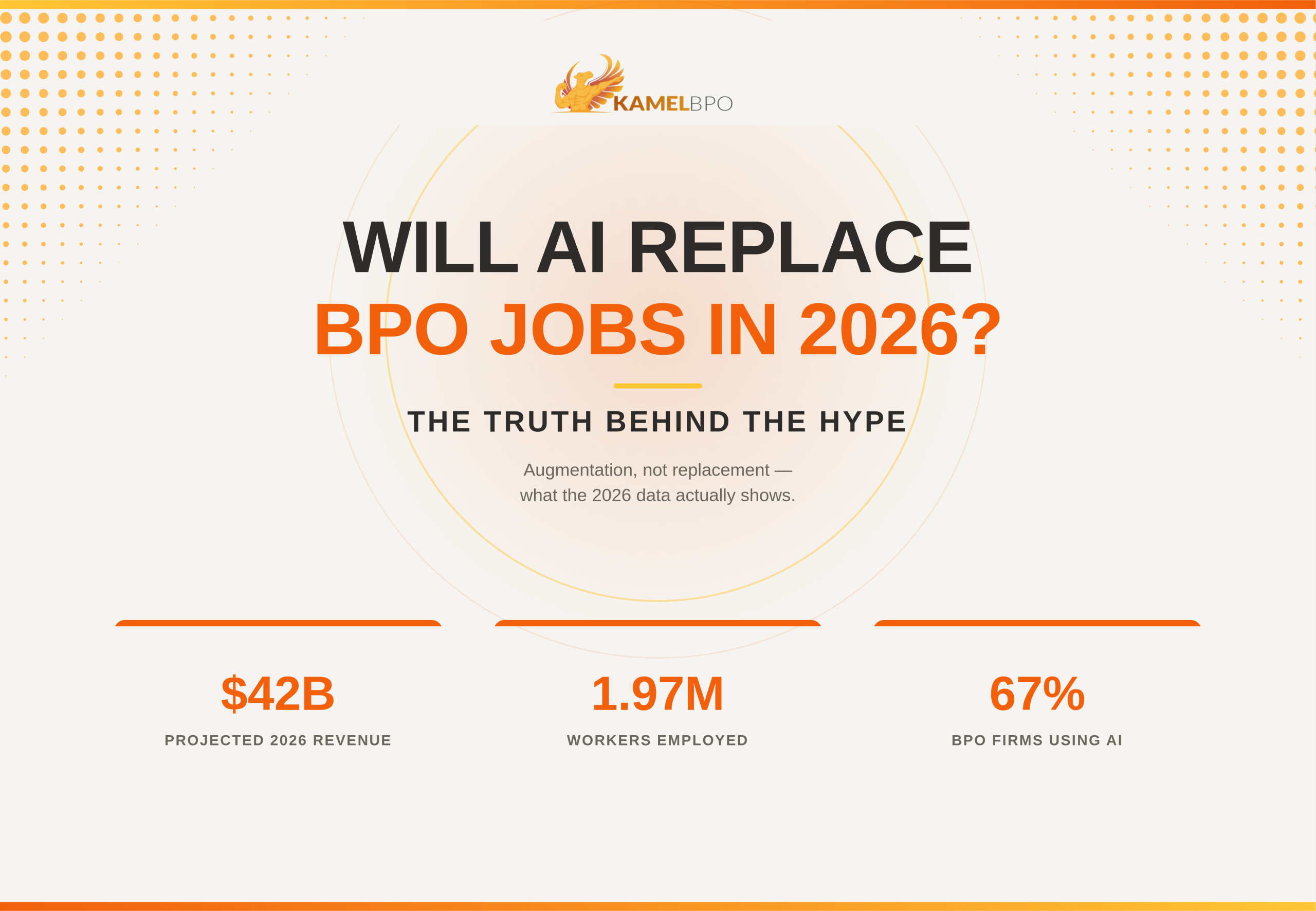
The Philippine IT-BPM industry closed 2025 with roughly $40 billion in export revenue and a workforce of about 1.9 million workers, and the IT and Business Process Association of the Philippines (IBPAP) projects the sector will reach $42 billion in revenue in 2026, with employment climbing toward 1.97 million. That translates to roughly a 5-percent increase in export revenue and 4-percent job growth for the year, outpacing the global outsourcing average. Longer-term, IBPAP’s Roadmap 2028 has targeted $59 billion in revenue and 2.5 million workers by 2028. However, more recent guidance has trimmed that ceiling somewhat as the industry recalibrates for AI-driven productivity gains rather than pure headcount growth.
Put those figures next to the global outsourcing market, which grew at roughly 3 percent in 2025. The Philippines grew faster than that. The sector now contributes more than 8 percent of Philippine GDP and stands as the country’s second-largest source of foreign exchange after remittances from overseas Filipino workers.
What the AI Adoption Data Actually Shows?
If AI isn’t replacing the industry, what is it doing inside it? The data gives a fairly precise answer.
According to IBPAP figures, 67 percent of Philippine BPO companies have already adopted AI tools in some form. That’s a majority of the industry, not a fringe experiment. But adoption doesn’t automatically mean displacement; it depends entirely on what the AI is being asked to do.
One of the clearest, most measurable effects shows up in training. Several major BPOs report cutting new-hire onboarding time from roughly 90 days down to about 30 days, a two-thirds reduction, by using AI-assisted training materials, simulation tools, and real-time coaching during calls. That’s a productivity gain for existing staff, not a reason to hire fewer of them. A company that can get an agent to full competency in a month instead of three months can absorb more client work with the same team, or scale up faster when demand spikes.
Look closer at which tasks AI is actually touching, and a pattern emerges. AI is strong at repetitive, high-volume, pattern-based work: routing tickets, drafting first-pass responses, summarizing calls, flagging anomalies in data, answering frequently asked questions. It is much weaker at relationship management, judgment calls under ambiguity, de-escalating an angry customer, navigating a client’s unwritten preferences, and taking accountability when something goes wrong. Those are exactly the tasks that make up the harder, higher-value parts of BPO work, and they’re the parts AI adoption data shows companies are not automating away.
That distinction is the core of the 2026 story on AI replacing outsourcing jobs. The evidence points to AI functioning as a productivity multiplier for existing staff, not a wholesale substitute for them. Industry reporting on IBPAP data has been explicit about this; companies frame AI adoption as a way to enable workers to focus on higher-value tasks requiring human judgment, empathy, and creativity, not as a workforce reduction tool. Some industry estimates even suggest AI-adjacent roles, like data curation and algorithm training, are creating on the order of 100,000 new jobs within the sector. If the goal were simply headcount reduction, you wouldn’t expect training investment, upskilling programs, and new AI-adjacent job categories to be growing alongside adoption.
Why are companies still choosing to outsource even when AI is available?
Deloitte’s Global Outsourcing Survey shows a striking shift. In 2020, roughly 70 percent of executives cited cost reduction as their primary reason for outsourcing. By 2024, that number had fallen to just 34 percent. Cost savings didn’t disappear as a factor, but it stopped being the dominant one.
What replaced it? Access to specialized talent, operational agility, extended coverage hours across time zones, and increasingly mature cybersecurity and compliance capabilities. Businesses aren’t outsourcing primarily to pay less anymore. They’re outsourcing to get skills and flexibility they can’t easily build in-house, and to do it faster than a traditional hiring cycle would allow.
That shift is a meaningful piece of evidence against the idea of AI replacing outsourcing jobs wholesale. If AI alone could substitute for outsourced human teams, cost-driven outsourcing would be the segment most exposed to disappearing, and yet the whole category of outsourcing demand is holding up, just for different reasons. In other words, the fear of AI replacing outsourcing jobs doesn’t match how buying decisions are actually being made in 2026. This simply means that businesses still want humans equipped with AI tools, not AI tools running unsupervised in place of humans. A chatbot can answer a routine question at 2 a.m. It can’t build a long-term client relationship, escalate a compliance-sensitive issue correctly, or adapt tone the way an experienced human agent can.
It’s also worth noting where demand is broadening rather than shrinking. Alongside large-scale traditional BPO, the SMB and virtual-assistant segment, smaller businesses and individual entrepreneurs hiring dedicated offshore talent directly is growing faster in percentage terms than the traditional BPO market. That’s demand expanding into new corners of the economy, not contracting into a smaller AI-only footprint. If AI were simply substituting for outsourced labor, you wouldn’t expect a whole new segment of outsourcing demand to be accelerating at the same time.
What’s actually Changing?
None of this means offshore jobs look the same as they did five years ago. They don’t. What’s changing is the shape of the role, not its existence.
AI-tool fluency is quickly becoming a standard hiring criterion, on par with English proficiency or typing speed used to be. Job postings for customer support roles increasingly list “experience with AI-assisted response tools” as a requirement. That’s a meaningful shift in what “qualified” means for an entry-level BPO hire.
In practice, this looks like:
1. Customer support agents using AI-assisted response drafting to handle routine questions faster, then applying their own judgment to review, personalize, and finalize the reply before it reaches the customer.
2. Data analysts using AI to generate first-pass insights and flag patterns in large datasets, then applying domain expertise to validate, interpret, and contextualize those findings for the client.
3. Content teams using AI to produce first drafts, then relying on human editors for accuracy, brand voice, nuance, and quality control before anything goes out.
In every one of these examples, AI compresses the mechanical part of the task and leaves the judgment-heavy part to the human. That raises the skill ceiling for the role rather than eliminating it. An agent who can operate AI tools, catch their mistakes, and know when to override them is more valuable and not less employable than one who can’t. This is precisely why companies are investing in upskilling rather than downsizing: the industry needs more people who can supervise and improve on AI output, not fewer.
This is also where staffing partners earn their keep. Recruiting for this hybrid skillset- someone who’s both a strong communicator and comfortable working alongside AI tools is different from recruiting for a purely script-based role, and firms like KamelBPO are already building their talent pipelines around exactly that combination. That’s a practical, forward-looking response to the possibility of AI replacing outsourcing jobs: instead of waiting to see what happens, leading recruiters are actively redesigning what “qualified” looks like so their candidates stay ahead of the curve rather than behind it.
The Limits of the Replacement Narrative
The optimistic case for AI augmentation shouldn’t be mistaken for a claim that AI is harmless or limitless. It has real, well-documented limits, and those limits are exactly where the “full replacement” narrative falls apart.
Current AI systems struggle with context that spans multiple interactions, nuance in tone and intent, and accountability when something goes wrong. They don’t build client relationships. They don’t carry institutional memory about a specific customer’s history the way a long-tenured agent does. And they don’t exercise regulatory or compliance judgment reliably, which is a serious problem in industries like healthcare, finance, and insurance, where a wrong answer isn’t just inconvenient, it’s a liability.
The Air Canada case is a useful, well-documented example of exactly this failure mode. In 2024, the airline’s customer-service chatbot gave a passenger inaccurate information about its bereavement fare policy. The passenger relied on that answer, booked accordingly, and Air Canada later refused to honor it, arguing and unsuccessfully that the chatbot was a separate entity the airline wasn’t responsible for. A Canadian tribunal rejected that defense and ruled the airline was liable for its chatbot’s statements. Research cited in coverage of the case notes that AI chatbots can produce inaccurate or fabricated answers anywhere from roughly 3 to 27 percent of the time, even in controlled deployments. That’s not a rounding error — it’s a real, ongoing risk in any customer-facing use case where accuracy carries legal or financial consequences.
For most small and mid-market clients, full automation isn’t just risky, it’s impractical. Building, monitoring, and correcting an AI system well enough to avoid these failure modes takes engineering resources, ongoing oversight, and guardrails that most SMBs simply don’t have in-house. Paying for a human-supervised offshore team, augmented by AI tools rather than replaced by them, remains the more reliable and more economical option for the vast majority of businesses.
What does this mean for businesses considering outsourcing today?
If you’re evaluating outsourcing right now, the practical takeaway is straightforward, to go hybrid. Offshore staff empowered by AI tools consistently outperform either extreme, an all-human team without productivity tools, or an all-AI system without human oversight.
When you’re choosing a BPO partner in 2026, a few things are worth checking directly:
1. AI-tool integration. Does the partner actually use AI to speed up training and improve first-response quality, or is “AI-powered” just marketing language on their website?
2. Training speed and quality. Ask how long it takes a new hire to reach full productivity. A partner citing something close to that industry benchmark of 30 days, instead of 90, is a signal they’ve genuinely modernized their onboarding.
3. Adaptability. Can the partner shift a team’s skill mix as your needs change — more data analysis this quarter, more customer support the next — without a lengthy re-hiring cycle?